Jaunt of the Argus
Arg'Akesh is the blue stone holy fortress of the Argus, god of truth, shields, and curved angles. Every four cycles (as four and its multiples are holy numbers), the Argus is called on a jaunt by the various celestial bodies influencing this meager planet we call Odom. Coinciding with the divining of the star chart that the Argus uses to map its journey, a host of Divine Escorts are selected to protect the Argus and to establish the new Holy Fortress wherever they may land.
Odom and Sau
The scholar priests of Kixax (God of Lenses and Puddles) were the first to discover that our sun is, on a cosmic scale, quite small. Sau, as she has been named by the Argus, is an immature, red star. Odom, on the other hand is a fragile, old planet that has seen far too much history. Because Odom is vulnerable, it needs to spend some of its time away from the brilliant heat that Sau emits. It is here where Odomites attribute divine kindness to Odom for subjecting itself to Sau's radiance so that we may grow our crops and keep the wasting at bay.
Cyclically, Odom will spend 20 years of its orbit within Sau's warmth and then 20 years out in the cold abyss. Days dissappear, people die having only known candlelight, and entire cities starve. The dark brings new creatures from the stars, outsiders that become permanent fixtures on the planet.
The people of Odom are deeply faithful as the gods walk the stony land with them. An immortal man calling himself Ilmarillion rules a golden city and appears to people through flames. Every lichen and fungus that is farmed in preparation for the long dark is a part of Don Don Solesh, the great god of mold and fabric.
The lands of Odom have been scarred by their time being subjected to the outer dark. The impacts of small meteors dot the surface. Numerous regions have been altered by the strange clouds that Odom drifts through in the later years of the long dark. One of the few constants is the fungal life that Don Don Solesh propogates across the planet with reckless abandon.
The population of Odom is made up of two primary species: Imps and Humans. Priests of Golgius, the Space Between Strikes, god of paintings and history, have records dating before the establishment of the Church of the Argus. It is said that in their deepest vaults they posess illustrations of the first Imps to the birthed from Odom's oceans. Humanity is understood to have arrived with Don Don Solesh some time after the beginning of Imp Civilization. Humans and Imps warred for hundreds of years before the Goddess of Imps ended their conflict for good.
Arg'Akesh
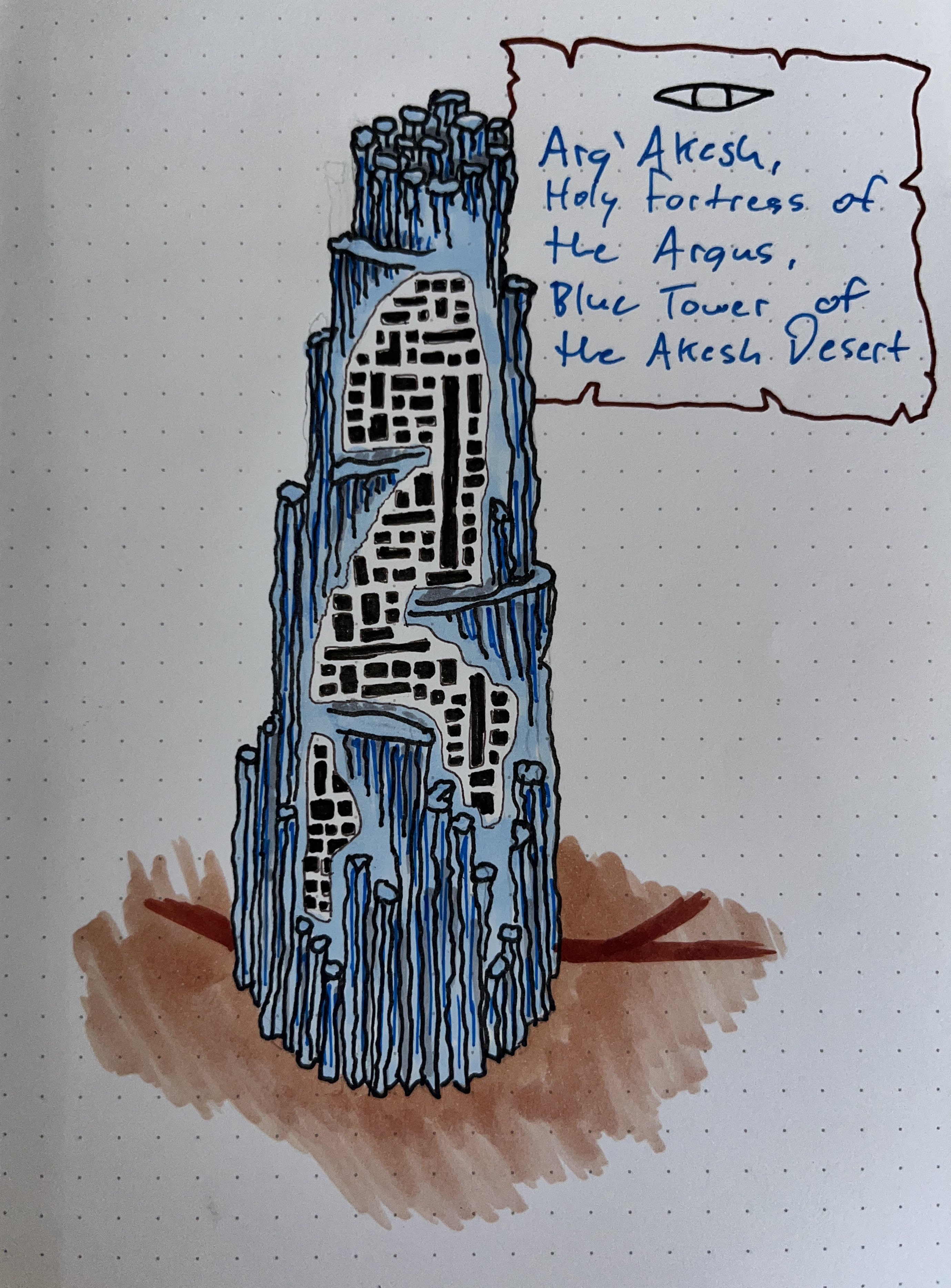
The city of Arg'Akesh was a built city, not a conquered one. Where the Church of the Argus meet with the Divine Escorts at the terminus of the Jaunt there shall always be a Holy Fortress, this is doctrine. When the previous Jaunt, the Jaunt of Wilting, ended in the Akesh Desert, it was only natural to carve the Holy Fortress into one of the blue stone pillars there. In the 80 years since its founding, Arg'Akesh has thrived due to its eminence as a pilgrimage destination.
The people of Arg'Akesh are a diverse bunch. The permanent population of the Fortress and the surrounding desert is 20,000 strong, nearly all of them devoted too the Argus. The city hosts a large number of pilgrims who stay both in and outside the Fortress, at any point there are typically 5,000 pilgrims visiting. The Holy Lenders of the Church of the Argus have leveraged the rare blue stone of the desert, making the Fortress quite prosperous.
The politics, economy, and society of Arg'Akesh is fully enmeshed within the Church of the Argus. The Church is unavoidable in day-to-day life within the Fortress. Those who do not share in the worship are not shunned, but they are noted as outsiders. Those who are born into Argus worshiping families in the city rarely leave the faith. Education typically occurs through mentorship and direct training, while wealtheir holy people and merchants may hire private tutors for their children.
the Argus
A kite shield. It is shaped like a teardrop. It is the purple of clouds absorbing the setting sun. Set in the face of the shield is an eye. Historical records say that it is the color of bone, or of paper, or of salt. When in the Holy Fortress the Argus is kep in seclusion and tended to by a blind attendant. It bathes in a shallow pool of salt water and valuable gemstones. When on its Jaunt, the Argus is wrapped in holy cloth. It is an unforgivable sin to wield the Argus, a grave one to covet its power.
It is called the Eyed Shield, the Silvery Cord, and Susir's Teardrop. It is god of truth and shields; curves and flat surfaces. It is said to know every lie as soon as it is told. It is said to whisper the secrets of hunting to animals and nursing to babies. It knows the true names of the stars in the sky and their wishes for the lives of men.
The Argus will weep a silvery liquid on a somewhat predicable pattern seemingly related to the movements of various celestial bodies. Imbibing this liquid at various doses is traditional in several rituals of the Argus, notably the conclusion of a Jaunt.